
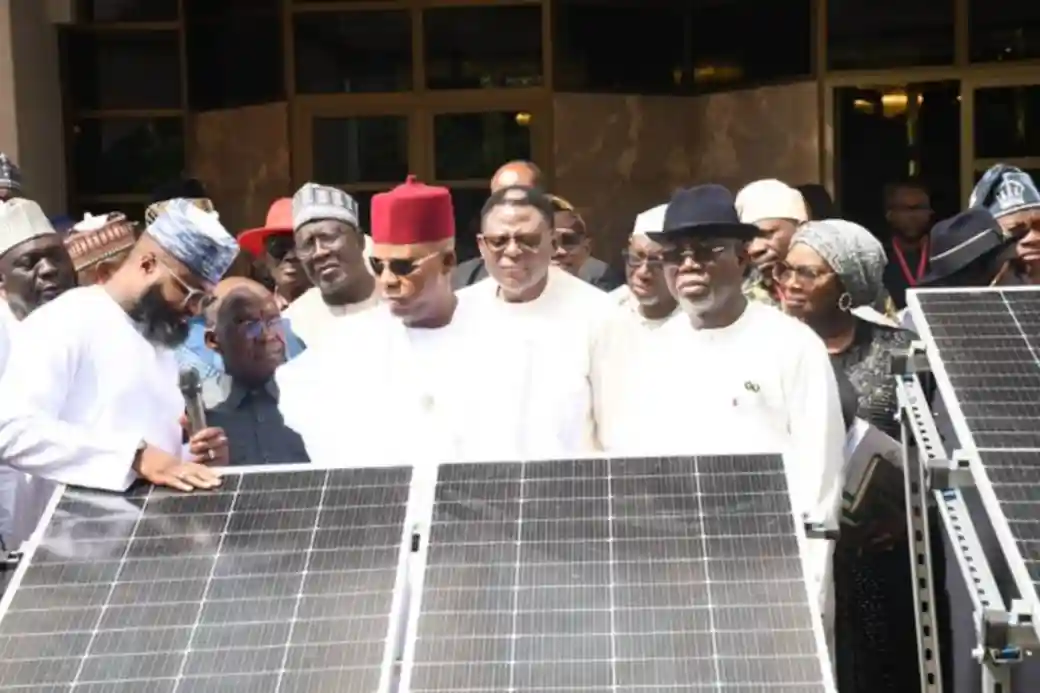
FG approves NASENI solar irrigation pumps for 2025 dry season farming
The National Economic Council (NEC) has endorsed solar-powered irrigation pumps produced by the National Agency for Science and Engineering Infrastructure (NASENI) for national rollout ahead of the 2025 dry season farming. The development is part of efforts to boost food security, reduce operational costs for farmers, and improve livelihoods across the country.
At its 152nd meeting held on Thursday at the Presidential Villa in Abuja, the Council approved the use of the NASENI solar irrigation pump, designed to replace petrol-powered pumps. The innovation is expected to increase agricultural productivity while reducing dependence on fossil fuel energy.
In anticipation of President Bola Ahmed Tinubu’s approval, NEC also mandated the Minister of Budget and Economic Planning, Senator Abubakar Atiku Bagudu, to design funding modalities that would enable NASENI to mass-produce the irrigation pumps and ensure their distribution before the 2025 dry season farming cycle begins.
Chairman of the Council, Vice President Kashim Shettima, described the endorsement as a step that demonstrates Nigeria’s ability to compete globally with innovation. He said, “We must also face the challenge of innovation in agriculture. NASENI’s scaled-up solar irrigation pumps are ready for national rollout ahead of the 2025 dry season. These pumps replace expensive petrol-powered systems, lower farmers’ costs, expand dry-season cultivation, and even provide backup power for households. Their advanced features, including GPS tracking, mobile app dashboards, usage monitoring, and pay-as-you-go integration, prove that Nigerian ingenuity can compete with the world.”
The Vice President noted that the innovation would strengthen food security and open new opportunities for carbon credits for farmers nationwide. He also highlighted other initiatives of the Tinubu administration targeted at agriculture and rural development. “Recently, 250,000 farmers have been insured across eight states, the 30 percent Value Addition Bill is advancing, and the ₦250 billion Bank of Agriculture facility is being activated to reach smallholders,” he said.
Updates from the Presidential Food Systems Coordinating Unit showed that the Green Imperative Project with Brazil is being restructured for financing, while the World Bank-backed AGROW programme is mapping priority value chains. According to Shettima, “The Harvesting Hope Caravan has reached half a million citizens in eight states, building trust and grassroots mobilisation. These are lifelines to farmers and proof that NEC’s decisions resonate beyond these chambers.”
The Council also reviewed national account balances as of September 17, 2025. The Excess Crude Account stood at $535,823.39, the Stabilization Account at N83,495,784,133.24, and the Natural Resources Account at N125,818,396,257.41.
During the session, the Nigerian Economic Summit Group (NESG) presented preparations for the 31st Nigerian Economic Summit with the theme, “The Reform Imperative: Building a Prosperous and Inclusive Nigeria by 2030.” The presentation outlined global trends such as uneven economic growth, divergent inflation, rising geopolitical tensions, and climate and technology shifts.
Key challenges facing Nigeria were identified as structural bottlenecks in energy and transport, political instability, frequent policy reversals, corruption, and over-reliance on oil revenues. The report also pointed to global pressures such as climate change, trade tensions, and competitive strain on the country’s weak industrial base. The Council committed to actively participate in the summit to mobilize support for President Tinubu’s Renewed Hope Agenda.
Another major briefing came from National Security Adviser, Mallam Nuhu Ribadu, who presented Nigeria’s Anticipatory Action Framework for Riverine Flooding. The framework aims to reduce humanitarian and economic losses from flooding by focusing on early warning, preparedness, and coordinated response in 13 high-risk states.
Objectives include protecting vulnerable households, institutionalizing anticipatory action across government agencies, and ensuring equity in response measures. The plan prioritizes multipurpose cash assistance worth ₦24 billion, while also supporting evacuation centers, child protection, and prevention of gender-based violence.
The framework revealed that 16 states have fully functional Local Emergency Management Committees (LEMCs), while 14 states have none, 4 have partial setups, and 3 depend on desk officers. The Council directed all high-risk states to establish effective LEMCs and provide targeted training to enhance grassroots preparedness. The framework also includes real-time monitoring, lessons-learned workshops, and reviews to improve accountability.
Council commended the Office of the National Security Adviser for the work and described the framework as comprehensive and visionary. It further directed that the scope should be widened to cover more states before final ratification at the next NEC meeting.
The Governor of Jigawa State also presented a report on the monthly cost of production survey and the impact of energy costs on food production. The memo highlighted challenges in agriculture, warning that high fertilizer and energy costs could worsen the food security situation. Recommendations included prioritizing fertilizer cost optimization through liberalized regimes and providing handheld farming tools for small-scale farmers who may not immediately benefit from tractor programs.
The memo also recalled President Tinubu’s directive from June 2024, instructing NASENI to ramp up production of 50,000 to 100,000 pumps for state-level distribution. In response, the Council resolved to address rising energy and fertilizer costs. The Minister of State for Petroleum Resources (Gas), Ekperikpe Ekpo, was directed to interface with industry stakeholders to address the high cost and availability of gas domestically and report back at the next NEC meeting.
The 152nd meeting of NEC ended with a reaffirmation of its commitment to strengthen food security, support innovation, and improve resilience against natural disasters, while also tackling structural and fiscal challenges facing Nigeria’s economy.